do you need a local video editor for your speaker reel?
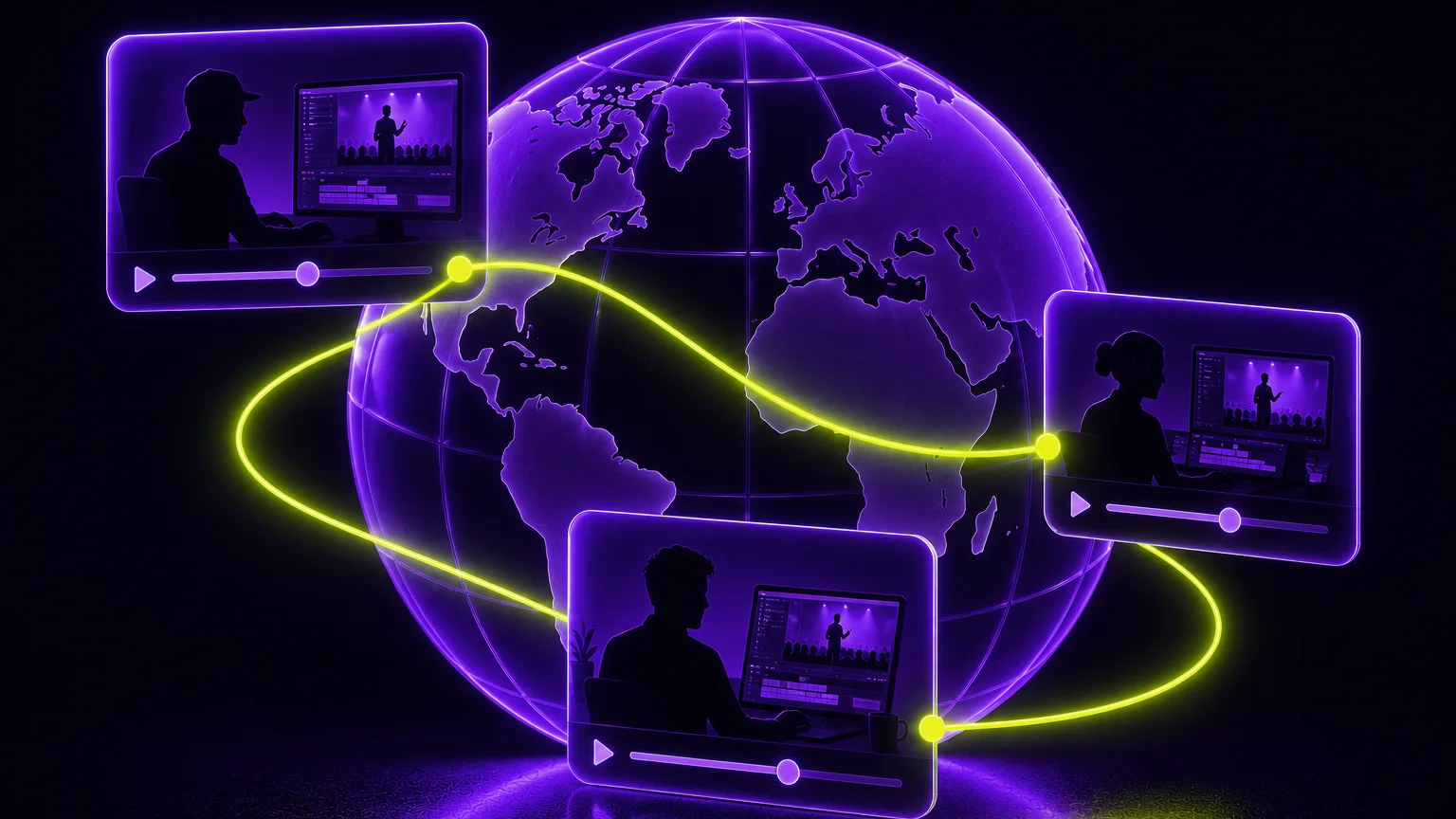
No. A demo reel is cut from footage you already have: keynotes, panels, podcasts, workshop recordings. The editor never needs to be in your city, because nothing new gets filmed. What matters is whether your editor understands how bookers watch reels, not which time zone they sit in. Location only matters when a camera does.
why does location feel like it matters?
The instinct is understandable, because most people picture video work as filming. A crew, lights, a camera on a tripod at the back of a ballroom. That part is physical. Someone genuinely has to be in the room. So the brain files video under local trades, next to plumbers and photographers, and starts searching nearby.
Editing is a different job entirely. Your reel gets built from talks that already happened: the keynote in Austin, the panel in Toronto, the podcast you recorded in your office. That footage exists as files, and files do not care about geography. Filming needs a person in the room. Editing needs a person who understands your room.
There is exactly one case where local matters: a fresh shoot. If nothing usable was ever captured, someone with a camera has to stand in front of you, and that someone should be nearby. But that is production, not editing, and mixing up the two is how speakers end up hiring the wrong person.
what actually matters in a reel editor?
Niche knowledge, first and always. A demo reel is not a highlight video, it is a sales document watched by event planners and bureaus who decide fast and move on. An editor who knows this opens with your strongest stage moment, shows a real audience reacting, and gets your credibility on screen before attention wanders.
A generalist editor in your city has probably cut weddings, real estate walkthroughs, and a restaurant ad this month. All fine work. None of it teaches you how a bureau watches the opening seconds of a reel. The editor's niche matters far more than the editor's address.
Then come the details that separate a reel that books from a reel that exists. Titles set in your actual brand, not whatever the software shipped with. Honest cutting, which sometimes means telling you a clip you love makes you look smaller than you are. And pacing built around how a booker skims, not how a filmmaker admires.
Price tells you less than you would hope. Freelancer marketplace gigs run roughly $185 to $600, specialist reel studios run $1,500 to $5,000, and premium production houses run $3,500 to $12,500. Every one of those tiers exists in every city, and none of them guarantees the editor has ever spoken to a booker.
how does remote speaker reel editing work in practice?
Simply. You send your footage over a private link: conference recordings, podcast appearances, phone clips from the back of the room, whatever exists. The editor reviews everything and comes back with a point of view on what is usable, what is missing, and what the strongest cut looks like.
Notes happen on a call. You watch the draft together, say what feels wrong, and the editor translates that into cuts. Then finals land in your inbox, ready for your website, your outreach, and the bureaus. No studio visit, no parking, no reason to limit your shortlist to a single postcode.
This is how we work at lazybranding. One studio cuts reels for speakers across the US, Canada, the UK, and Australia, and the process is identical whether the client is in Denver or Dubai. The full walkthrough lives on the speaker demo reels page, but the short version is: footage in, decisions on a call, finished reel out.
when should you hire local?
When a camera needs to be pointed at you. If you have no stage footage at all, or everything you have is blurry and far away, you need a shoot before you need an edit. That means a videographer in your city, or better, arranging professional capture at your next confirmed talk.
Even then, the roles stay separate. The person filming your keynote and the person deciding which eight seconds of it open your reel are doing different jobs with different skills. Hire the camera locally if you must. Hire the judgment from wherever the judgment is best.
And if you are not sure what you actually have, that is a solvable problem. The $500 brand audit looks at your existing footage alongside the rest of your brand and tells you plainly whether you are one edit away from a working reel or one shoot away from starting properly.
questions, answered.
how do revisions work remotely?
You watch a draft link and leave timestamped notes, or we walk through it together on a call. The editor cuts a new version and sends a fresh link. Most speakers find this faster than driving to a studio, because notes get written the moment you spot something.
is my footage safe over a link?
Yes. Footage moves through private transfer links, not public uploads, and you always keep your originals. Nothing is published anywhere until you approve the final cut. The riskiest place for your footage is usually the conference organizer's inbox, not the transfer to your editor.
what about time zones?
Editing is quiet work that happens while you do other things, so time zones barely register. The only live moment is the notes call, and one overlapping hour is easy to find between the US, Canada, the UK, and Australia. Everything else moves by inbox.
what if i have no footage at all?
Then editing is not your first step, filming is. Book professional capture at your next confirmed talk, or a local videographer if you need something sooner. The $500 brand audit can look at what you have and tell you honestly which path you are on.
do bureaus care where my editor sits?
Not even slightly. A bureau watches the reel, checks whether you command a stage, and decides whether to put you in front of clients. No booker has ever asked for an editor's zip code. They ask whether the first moments make them want to keep watching.